A streaming subscription decision is easier when you treat the trial like a small test project instead of a quick impression. The question is not whether the first channel opens once. The useful question is whether the service, devices, terms, support path, and household expectations fit together under realistic conditions.
This guide gives US viewers an evidence-based way to evaluate a streaming service before subscribing. It avoids fake reviews, unsupported rankings, and invented performance claims. Use it with the provider's own documents and your own trial notes. For verified FreeGoTV navigation, start at FreeGoTV, then compare the public pricing, free trial, and refund policy pages.
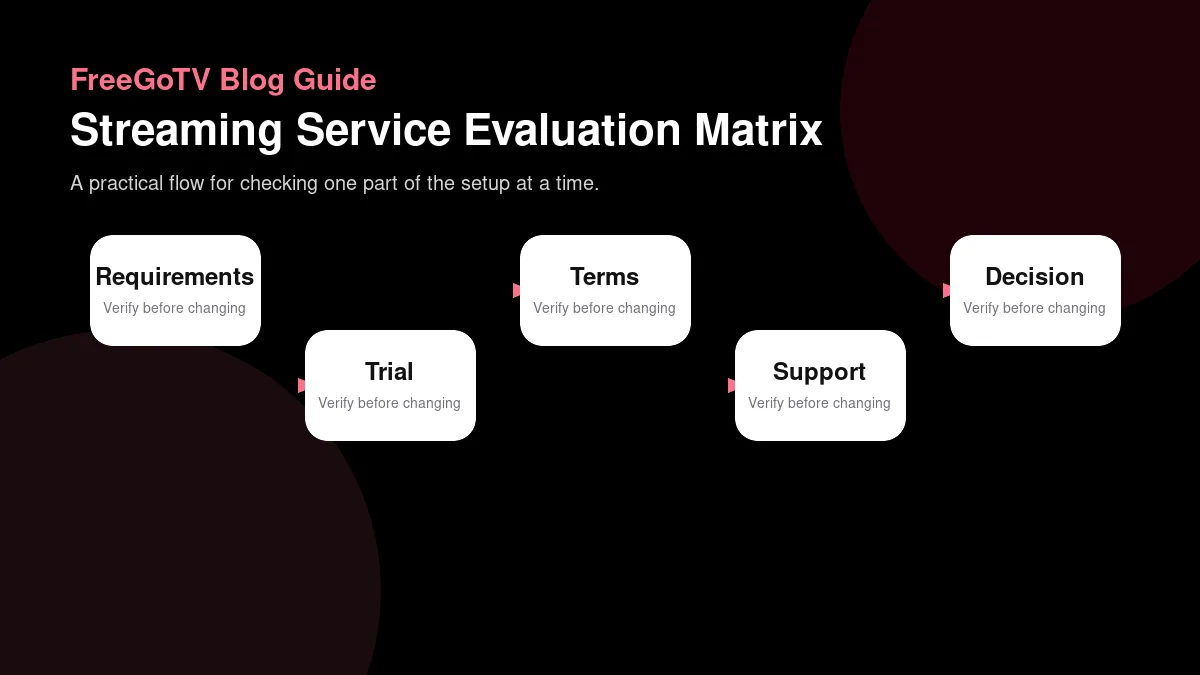
Write your requirements before testing
| Criterion | What to test | Positive signal | Warning sign |
|---|---|---|---|
| Device fit | Install and use the service on the actual primary screen. | Setup path is documented and works without unusual workarounds. | Only a different test device works or support cannot confirm your model. |
| Normal viewing | Watch during the time and network conditions you actually use. | Playback, guide, audio, and controls remain usable beyond a quick launch. | The trial only works under ideal conditions that do not match daily use. |
| Terms and renewal | Read plan, trial, refund, and renewal information before payment. | Written terms match the way you intend to subscribe or renew. | Important conditions are unclear or only described in vague chat messages. |
| Support quality | Ask one realistic, specific setup or plan question. | The answer is specific, safe, and consistent with public pages. | The response pressures payment or avoids direct compatibility questions. |
| Decision record | Write pass, fail, untested, and open questions for must-haves. | The final decision follows evidence rather than a single impression. | A major requirement remains untested but is treated as confirmed. |
Separate must-haves from preferences
Before starting a trial, write down what must be true for the subscription to make sense. Must-haves might include a primary living-room device, captions, a specific category of programming, predictable support, or a budget ceiling. Preferences might include a particular interface, fast channel switching, or a remote layout. Requirements help you avoid being distracted by features that do not solve your real need.
Name the household context
Be specific about the household. A single viewer on one television has different needs from a family with multiple rooms and shared internet. A sports-focused viewer may care about live delay and event reliability. A viewer replacing a traditional package may care more about guide clarity and channel discovery. Write the scenario in plain language.
Include accessibility and comfort requirements. Text size, captions, audio output, remote simplicity, and color contrast can determine whether a service is usable. These needs should be tested during the trial, not discovered after payment. A service that looks impressive to one person may still be a poor fit for another user in the same home.
Turn the list into a simple scorecard: requirement, test method, result, and notes. The scorecard keeps the decision grounded when marketing language, discounts, or frustration push you toward a rushed choice.
Verify access and documentation
Look for clear setup paths
A trustworthy evaluation begins with documentation. Can you identify how the service is accessed, which app or player is supported, which devices are recommended, and where help is available? Broad statements such as 'works on all devices' are less useful than a documented setup path for your exact platform.
Do not infer features from broad wording
Do not infer unlisted features from general IPTV language. A page that mentions channels does not prove a particular local affiliate is included. A mention of smart TVs does not prove your model has a native app. A reference to a guide does not guarantee full schedule data for every channel. Ask for confirmation when a feature is essential.
Use existing public pages as boundaries. If a site has an installation page, compare your device against it. If a pricing page lists connection tiers, read how they are described. If a refund page exists, read it before subscribing. For FreeGoTV, those public pages include installation, pricing, and free trial.
Keep copies of terms, setup instructions, and support replies that affect your decision. You do not need a legal archive for every sentence, but you should save the details that matter: plan length, renewal behavior, connection limits, trial terms, refund conditions, and support contact path.
Design a realistic trial
Test at normal viewing times
A trial is most useful when it resembles normal use. Test during the hours you actually watch, on the device you intend to keep, over the network you normally use. A lunchtime test on a phone is not enough if the real use case is a living-room television at night while other people are online.
Use the actual device
Run a short startup test, then a longer stability test. The startup test checks installation, sign-in, channel loading, audio, and guide behavior. The stability test checks whether playback remains usable after twenty to thirty minutes. If live events matter, test a live event rather than only on-demand or quiet channels.
Change one variable at a time. If the service works on Ethernet but not Wi-Fi, record that. If it works on one device but not another, record the models and app versions. If guide data is accurate for one channel category but missing for another, record examples. The goal is to learn whether a limitation is acceptable, fixable, or disqualifying.
Do not overload the trial with unrealistic stress tests that you would never perform in daily life. The service should meet your real requirements, not an invented torture scenario. At the same time, prioritize the features that matter while trial access is available.
Check limits and terms before paying
Connection limits need plain interpretation
Connection limits can mean different things: simultaneous streams, registered devices, household screens, IP locations, or account sessions. Do not assume one phrase covers all cases. If a plan lists several connections, ask whether that means simultaneous playback and whether devices can be changed. This matters for families, travel, and replacement hardware.
Refund terms matter before problems
Read renewal and cancellation language before subscribing. A low monthly price is less attractive if cancellation is unclear or support cannot explain it. If the service offers a trial, understand the trial terms and what happens afterward. The purpose is not suspicion; it is informed consent.
Refund policies should be read while you are calm. After a problem appears, it is easy to misremember what was promised. Save the relevant policy page and ask questions before payment if a condition is ambiguous. For FreeGoTV's public terms, review the refund policy alongside plan information.
If support makes a specific promise that affects your purchase, keep the written reply. Verbal summaries disappear. Written evidence helps both sides resolve misunderstandings about devices, plan scope, or trial expectations.
Evaluate trust signals without relying on fake reviews
Separate first-party claims from independent evidence
Reviews can be useful when they are genuine, recent, and specific. They are not useful when they are invented, copied, or presented without context. First-party marketing copy is not the same as independent customer evidence. If verified reviews are absent, acknowledge the gap rather than filling it with assumptions.
Support quality is observable
Trust signals include clear contact information, consistent pricing, readable policies, realistic technical claims, and support that answers specific questions without pressuring you. None of these proves perfection, but together they make the decision less opaque. Vague answers to direct compatibility questions are a warning sign.
During a trial, test support with one legitimate question. For example, ask which app and device path is recommended for your exact setup. Evaluate whether the answer is specific, safe, and consistent with public documentation. Do not test support with abusive or artificial demands; the goal is to see how ordinary help works.
Avoid treating social-media account names, hashtags, or third-party posts as proof of ownership or service quality unless the provider verifies them. The earlier keyword analysis for this project specifically avoided inventing official social accounts from discovery data.
Make a decision record
Use evidence, not vibes
After testing, complete the scorecard. Mark each requirement as pass, fail, uncertain, or not tested. Add short evidence: device used, time tested, result, and any support reply. This turns the subscription decision into a review of facts rather than a debate about impressions.
Know when to walk away
Uncertain items deserve attention. If a requirement was not tested, decide whether you can live with the unknown. If you cannot, ask before paying. If a support answer remains unclear, treat that uncertainty as part of the decision rather than assuming the best or worst.
Know your walk-away criteria. A service may be unsuitable if the required device is unsupported, essential content cannot be confirmed, guide data fails for must-have channels, support cannot answer basic questions, or terms are unclear. Walking away from a poor fit is not failure; it is the purpose of evaluation.
If the service fits, keep the setup notes and support replies after subscribing. They will help when replacing devices, troubleshooting buffering, or explaining the system to another household member.
Build a simple decision matrix
Weight what matters most
A decision matrix does not need to be complicated. List requirements down the left side and give each a weight from one to five. Device support might be five, interface preference might be two, and a secondary channel category might be three. Then score the trial result. The point is not mathematical perfection; it is making priorities visible.
Use notes beside each score. A four for device support might mean the app works on the main television but not on a travel device. A two for guide quality might mean schedules are present but time zones need support clarification. Notes prevent a number from hiding the evidence behind it.
Compare alternatives fairly
If you are comparing multiple services, test them under similar conditions. Use the same device, same network, same time window when possible, and comparable content categories. A service tested over Ethernet should not be compared casually with another tested over weak Wi-Fi in a back room.
Keep price in the matrix, but do not let it erase must-have failures. A low price for an unsupported device is not a bargain. A higher price may be acceptable if it solves the household's actual requirements and provides clearer support.
Identify unknowns before subscribing
Some questions may remain unanswered after trial testing. Maybe you did not test travel, several simultaneous screens, or a seasonal sports event. Write those unknowns down and decide whether they are acceptable. Unnamed uncertainty often turns into disappointment later.
Ask targeted questions for high-risk unknowns. Instead of asking whether a service is good, ask whether a specific device is supported, whether a connection count is simultaneous, or what support needs to verify a channel issue. Specific questions produce usable answers.
If the answer affects payment, wait for a clear written response. This protects the viewer and the provider because both sides can refer back to the same statement. A rushed subscription based on an assumed feature is avoidable.
Subscription trial scorecard
Record trial evidence before payment
Use a short worksheet before making changes or contacting support. For subscription evaluation, write the device, app name, app version, network path, time of day, and the exact result you observed. Then add what you expected to happen and why. This turns a vague impression into evidence that another person can understand without standing in your living room.
For a subscription decision, split the worksheet into must-have requirements, nice-to-have preferences, evidence gathered, and open questions. A trial can feel positive while still failing one essential requirement. The separation keeps a smooth first impression from hiding a missing device path, unclear renewal rule, or feature that matters every week.
Score evidence only when it matches the real use case. Watching one channel on a phone is helpful, but it does not prove the living-room device, simultaneous connections, guide behavior, captions, or evening network performance. Give each requirement its own pass, fail, or untested status so the final decision is based on coverage rather than memory.
Add a terms checkpoint before payment. Record the price, billing period, connection count, trial terms, refund conditions, and any availability caveats stated on public pages or in written support replies. If a requirement is not documented, mark it unknown rather than assuming it is included. Unknowns are acceptable only when they are not critical to the purchase.
Keep trial notes private and shareable
Keep trial notes private enough to share selectively. The worksheet can include device models, times tested, channels or categories checked, and support answers, but it should not store payment data, passwords, complete activation messages, or account identifiers. If several household members are reviewing the trial, share the scorecard rather than the raw account communication.
Use the worksheet to ask focused pre-sale questions. Instead of sending the whole trial log, ask about the specific unresolved requirement: an exact device, a simultaneous-screen scenario, a billing term, or a support process. Written answers to narrow questions are easier to compare with the website and easier to revisit if expectations later become unclear.
Before deciding, summarize the result in one sentence for each must-have. For example: living-room playback passed, guide accuracy untested, refund terms reviewed, second screen confirmed. This makes the decision deliberate. It also gives you a clear record of what changed later if a future plan, device, or household need no longer matches the original evaluation. Keep the final yes-or-no tied to those requirements, not to a temporary promotion or a single impressive demo.
Finally, connect this worksheet to the rest of your streaming decision. Evaluation notes should show must-haves, tested evidence, unanswered questions, and the written terms that matter before payment. If you need broader context, use the pricing, trial, refund, setup, and compatibility pages. The best streaming setup is not the one with the most undocumented tweaks; it is the one whose requirements, limits, and recovery steps are understood by the people who use it.
Review the trial record before subscribing
Before subscribing, perform one quiet review of your notes away from the television. Ask whether each must-have passed, whether any failure has a credible fix, whether the written terms match your intended use, and whether support answered the questions that mattered. Do not let a single exciting feature compensate for a failed requirement that the household will encounter every day. Also do not reject a service for a minor preference if the essentials are strong and documented. The value of an evaluation process is balance: it protects you from hype, but it also protects you from overreacting to one harmless imperfection. Make the decision from the whole record.
Connect evaluation notes to renewal risk
A good trial record also makes future renewal decisions easier. If you subscribe, keep the same scorecard with the plan duration, device count, support path, and open questions. When renewal time arrives, you can compare what changed instead of starting from memory. If you need renewal-specific preparation, use the FreeGoTV renewal payment guide after the service evaluation is complete.
This is especially useful when a household grows from one screen to several, replaces a streaming device, or begins watching more live events. A service that fit the original trial may still need a plan or setup review later. Treat renewal as a quick re-check of requirements, not just a payment action.
FAQ
What should I test during a trial?
What should I test during a trial? Cover your real use case: installation, a normal viewing session, guide checks, support contact if needed, and simultaneous-screen behavior if relevant. A quick sample alone is rarely enough for an important household subscription.
Should I trust review pages?
Should I trust review pages? Treat them as leads, not proof. Look for specific details, dates, screenshots that do not expose private data, and consistency across sources. Avoid pages that make extreme claims without evidence or use generic praise that could describe any service.
What if the price is good but documentation is unclear?
What if the price is good but documentation is unclear? Ask for clarification before paying. Low price does not fix unsupported devices, vague terms, or missing must-have content. A subscription should be evaluated by fit, not by price alone.
Conclusion: turn the trial into a clear decision
Turn the trial into a clear decision
Evaluating a streaming service is less stressful when you define requirements, test realistic conditions, read terms, and record evidence. The result may be yes, no, or not yet enough information. All three outcomes are better than guessing from a headline or a copied review.
Your next step is to build a one-page trial scorecard and test the exact device you plan to use. Use FreeGoTV for site navigation, compare pricing and free trial details, and keep your notes with the setup checklist for future troubleshooting.